Sunday, 17 April 2011

Reporting from a closed country

J-Fro welcomes you to Burma

For us, Burma/Myanmar was a country of mixed emotions. A hugely interesting country, struggling out of it's government-imposed backwards ways. Almost completely closed off from the rest of the world, the Burmese make it an unbelievably friendly place to visit.

Fisherman sifting through the reeds, Inle Lake

From arriving into Yangon airport and jumping into a 1960s Toyota minivan with 2 working doors (of 5), it was clear something was different. It wasn't just that despite all the cars being right-hand drive everyone drove on the right. It wasn't just the decaying soviet-era buildings and vehicles in the final stages of disrepair, or the strange looking cream paste on everyone's face. It was as though Burma is hiding something, but wanted desperately to unveil it. There is a national identity that the Burmese seem to be striving to show, but that rarely gets portrayed outside of the borders thanks to severe economic sanctions and a total media blackout (the Myanmar Post, the joke of a national paper, finishes every issue with a large advert about the evils of the BBC and various other international news agencies).

No ATMs in the whole country means you have to carry all your money for your whole trip,
as evidenced by Miss Moneybags Mills here

Dollars must be in a pristine condition to be exchanged, however the local currency "kyat"
is often torn or held together by sticky tape - these notes were in a pretty good condition considering!
On arrival at the first hotel, following a huge welcome by the several generations of family that run it and meeting our friends who had just toured Burma, we were confused by their apparent contradictions in their descriptions ("you'll be exasperated" "it's incredibly beautiful" "you'll struggle to find a decent meal" "they're so friendly" "you'll hate the transport"). Clearly this country wasn't going to be a simple love or hate affair.


We can't fault the Burmese people for some of the negative views we came away with, as during our 3 weeks there they proved to be the most welcoming and friendly nationality we have come across on our travels (particularly those in Shan state around Inle Lake). Because of the enforced isolation of the country they are still bemused by and very inquisitive of foreign faces in their lands, and whilst every man and his dog will stare at you like you've just stepped off a spaceship, they will almost always follow that up with a huge welcoming smile and call 'Mingalabar!' to you (hello, or literally 'auspiciousness to you') even if flying past on top of a truck.
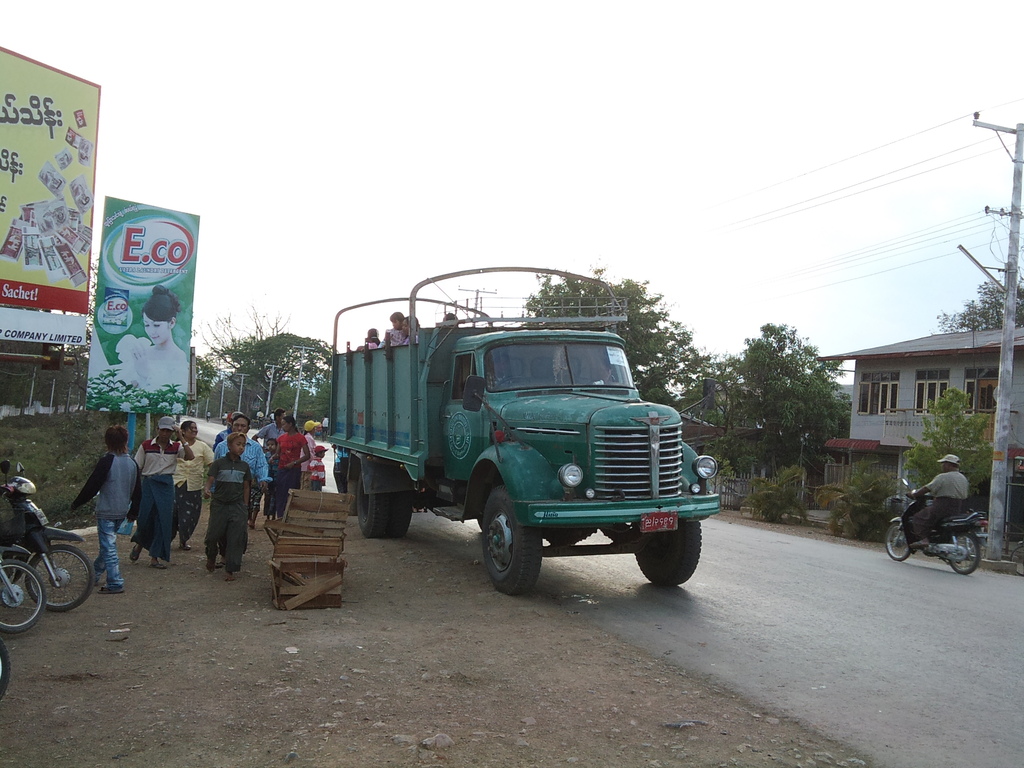
A common mode of transport for locals, and us at times

Trains are mostly used by locals as foreigners are charged 10x the normal price

But foreigners don't always get luxury treatment!

Yangon is a fairly faceless ex-capital city with few things to do or see. An exception to this is Shwedagon Paya, THE temple of the country. Beautiful.


Ringing the bell 3 times brings good luck, they say


A young monk befriended us and offered to give us a tour around the temple, pointing out the various hidden gems and treasures (such as 'this is the bell the British stole in 1852' ....ah I see....) for a small donation towards his monastery. We found that in many religious sites young monks would often come and introduce themselves, as this is the best way for them to practice their English.


In a country where most forms of communication are highly restricted and monitored by the government (you need an expensive license to own things such as landlines, mobiles - a sim card costs $2500 - even household items such as fridges!), it is no surprise the locals have found ways around it and street phones are a common sight throughout Burma.


Our first port of call was the fabled golden rock of Kyaiktiyo, which legend says maintains it's precarious balance due to a precisely placed Buddha hair. The only way up the mountain (barring a 5 hour walk) is in the back of one of the large flatbed trucks, in which 60+ people are crammed in, then driven up the steep mountain "road" at breakneck speed. After getting off we understood the need to cram in everyone so they can't move, as we would have lost most of the passengers otherwise.


Arriving to the top we still had 45 minutes walk to go to reach the golden rock. There was not a single foreigner in sight the whole morning, which meant that we were the focus of much attention and were even asked to pose for a series of photos with a Burmese family on holiday. Despite their sombre looks (photos are apparently a serious affair) they were all smiles before and after so the experience was awkwardly amusing.

After they had taken 7 photos we had to get one with ours
A young devotee counterweights the boulder with gold leaf

One of the more out-of-place sights we saw on our pilgrimage to the top was a young monk, cool as you like, with fancy headphones on, trendy shades and clutching a Sony PSP... sorry I was too slow with the camera for that one!

At this point I should mention the transport. Travel in Burma is.... well.... interesting. The bus seats are around 30cm wide, and the "roads" are patches of tarmac randomly placed every few metres or so - we since learnt that they are manually prepared, as we passed a patch-up operation with many women with small wicker baskets of tarmac filling the holes with their bare hands! On the buses during the night they wake you every hour or two for a "tea break", making the whole bus get off and stand outside at for half an hour, only to arrive at the destination, more often than not, around 3.30am. Did I mention they play children's karaoke videos full blast on every bus until midnight?

Just about to be engulfed by the local kids, Inle Lake

Our next port of call was Inle Lake, where we stayed for several days at the delightful Queen Inn. A family-run operation, we nicknamed the matriarch "Mama Queen" as she became like a mother to us those few days... sublime home-cooking, fresh strawberry juice whenever we were hot... she really could not have been more hospitable.


Blending in with the locals
      
Not my best look ever


The food is not the greatest in Myanmar (very oily) but we found a great restaurant called Smiling Moon where we befriended the owner, a beautiful lady called Thanda, and became regular guests sampling the home-made tagliatelle that even the most finickety Italian would be pleased with, among other more local dishes After many chats about social life in the town and the gossip - the local 'dragon' woman.... we organised a boat trip with Thanda for a day on the lake.


Sadly the lake is rapidly disappearing due to over-logging (by the government) in the local area causing land slides and soil erosion which is filling the lake. So at its deepest it is only 2 metres and we (James, myself and Yolene a lovely french lady we shared the trip with) were regularly bottoming out our canoe to the amusement of many onlookers. Due to the water shortage on one of the canals leading off the lake they have constructed a series of locks with narrow gaps for the boats to pass through, so the drivers have to have a good aim and gun it through so as not to get stuck. We were very impressed with our driver Couteau's skills and had a great time narrowly missing collisions with other long boats.


The local fishermen have an ingenious way of rowing with their legs so as to keep their hands free to fiddle with the fishing net. To me it looked like a crazy yoga pose, not the easiest method I am sure but very impressive and beautiful to watch. 


Yeah! Made it up the 942 steps of Mandalay Hill to see... another temple! Woohoo!
Reluctant to leave our new home we jumped on another delightful overnight bus on the road to Mandalay, which is certainly not as romantic as the name implies. Coming down from the mountains into Mandalay the temperature skyrocketed into the mid-40s, giving the hectic dusty town a dirty steam-room type feel to it. Unsurprisingly we didn't stay too long, after seeing a couple of sights we took the shakiest bus ever to Bagan - 6 hours of roads in such a bad state that the bus windows had been repeatedly re-sealed with sticky tape.


There are over 4,000 temples scattered about the area, in such a way as to give an almost fairytale atmosphere. We were pushed for time as it was becoming increasingly clear that the country's decrepit internet system just couldn't handle the type of connections James needed for work, so we were making arrangements for a swift exit back to Thailand. As a result we did our pagoda tour on bicycles in the heat of the day, and even when cycling at speed it's no cooler, just feels like someone is blowing a hair dryer in your face. Despite the heat we did manage to sample some of the breathtaking views, although we paid the price by burning our feet on the blisteringly hot stone brickwork. 


Hey!
    
A dehydrated Beth struggles to catch up


Oh look, yet another temple...

From Bagan we indulged in a (non-government) flight to Yangon to avoid yet another bus journey and found that this was how all the Spanish travellers got around! We arrived back into Yangon for the start of Thingyan, the new year's water festival - where everyone drinks a load of whisky and has water fights all day long. We thought this was crazy but little did we know that the Thais really know how to step it up a gear... more on that in the next post!


Christian finds some spice in our Burmese buffet dinner - with more than 16 different dishes!

I'll leave you with Beth enjoying a palm-tree beach swing on Ko Chang... :)


Thursday, 24 March 2011

The Island


After being on our own for Phnom Penh and Kampot, we arrived in Sihanoukville meeting up with our band of fellow travellers and organised a boat across to the island of Koh Ta Kiev.
So like voyagers off to foreign lands we boarded our vessel, wading through chest-high waves to load our luggage.


Approaching the beautiful island of Koh Ta Kiev it appeared completely deserted, except for 5 small bungalows set back from the beach amongst the trees and one big hut on the beach edge. We docked in much the same manner as when we set sail from Sihanoukville, minus the waves.


We had brought food supplies from the mainland, and a big cooking pot, so in our bungalow that 5 of us shared we created a larder, giving it a very homely feel!


Balancing on the nipple!


Our stay here was sheer bliss, daytime hours were spent discovering the island's coastline, swimming, searching for shells, reading, or following trails through the jungle. Our evenings were spent cooking one-pot dinners and drinking home-made lemongrass and ginger tea spiked with good measures of cheap whisky!


A short walk along the beach and a very short trail through the jungle to find another small bay - the most amazing bar/restaurant, also providing treehouses and hammocks to stay in. From what we saw of Cambodia this is it's gem - and if you ever have the opportunity to go there you should swing by 'Ten103 Treehouse Bay' (the coordinates of it's location) and say hello to Joel and Roberto, an american/italian pair of chefs. There's not much information online as they don't like to advertise much, thus keeping the intimate tranquility intact.


Unfortunately their accommodation couldn't fit 9 of us so we stayed at Tom's bay, but spent much of our time hanging out there, lazing around with the uber-chilled cat with no name, enjoying brick-oven cooked sweet bread filled with raisins accompanied with caramel sweet milk, special cookies delicious coffee and good conversation.

Breakfast time

The atmosphere of the place coupled with nature at it's best and great company made the hours drift by like seconds. I'm sure in time the island will become more developed but currently it's a beautifully lonely island - there were times when James and I had the entire 5km beach to ourselves.


Needless to say we had the most peaceful time on Koh Ta Kiev, and came away with some very fond memories - to mention a few: Roberto's welcome, peeling and de-seeding 4 kilos of tomatoes to create Martin's special soup, searching for Shiva eyes and the 'perfect' shell, morning ritual of a dip in our private ocean, disco night jungle walk, the incessant mosquitoes that "don't deserve to live as they are just not polite!".


It was sad to leave but all good things come to an end... only to create space for more. We jumped off the beach at Otres beach, a quieter bay 4km from Sihanoukville, where we found a great guesthouse called Done Right with an inviting atmosphere and a creative way of building recycling cans and bottles instead of bricks. Check out their site here - the first pic is the dome we stayed in! Good ideas.


The guesthouse is not quite finished as they only started building 3 months ago after their previous site further up the beach was bulldozed and re-claimed by the government to turn it into a National Park. The guys who run the place are very chilled and sporting an array of pets, all as young as the bar. My favourite, Ninja (Felix) the ginger kitten, rivals the cat-with-no-name from Ten103 for uber-chilledness and comes up 2 steps ahead. He loves to be loved and being so small and cute he sure is loved.

ahhhhh.... Ninja!


The 2 sibling pups who speed around the volleyball court at lightning speed, and a fully tame chicken, being raised from a chick on her owner's shoulder. She would sit on the back of your chair and peer over your shoulder at your laptop, occasionally stretching her leg in a ballerina-style move.


From Otres beach we headed back to Thailand. We finally arrived at the border after a laborious bus ride - we got 2 flat tyres, the engine broke several times causing us to stop regularly and finally the air-con broke, pouring rivers of water onto the back seats. Luckily people on those seats could move forwards as the bus was no longer completely full by then, as many people fed up of the incessant delays had hailed passing traffic to taxi them to the border.

The border crossing into Thailand featured no corruption unlike the Cambodian one - efficient with no "extra" charges. It reminded me of arriving into France from Spain, because all of a sudden everything seemed to be much more ordered and organised. It feels good to be back in Thailand - we went out for dinner straight away to enjoy a Pad Thai (james' favourite) and Tom Yam Goong, the best soup in the world! That very much introduced me back to the spicy food we had been missing while in Laos and Cambodia.


Keen for more island life we took the ferry to Ko Chang with Lolle and Phil, who we've been travelling on and off with for the past 6 weeks. We hired motorbikes, ran out of fuel 3 times in just one hour.... drank some SamSong (rum), swung in hammocks and beach swings for hours and chilled out with the locals. Now we are in smelly Bangkok impatiently awaiting a flight to Yangon in Myanmar - our 4th country.

Even the trees show their love on Koh Ta Kiev!

Wednesday, 23 March 2011

Sombre sightseeing


Phnom Penh is home to Tuol Sleng (S21) - the former school used by the Khmer Rouge to carry out some of the most inhumane acts of torture and murder imaginable, and of course the Killing Fields. Not the most pleasent of site-seeing but both James & I felt it necessary to understand how it has shaped the Cambodian culture of today. The tension in the air at S21 is highly charged. Walking around it was easy to imagine the building's original purpose, children happily hurrying about corridors and stairwells, however its recent use as an  interrogation and torture prison filled the air with death and destruction. Evidence was everywhere, from the blood staining of the floor tiles, Khmer Rouge rules of conduct chalked on the blackboards, the tiny cells created within the buildings, not to mention the horrificly graphic photographs.


We took a 15km cycle ride to the Killing Fields in the stinking heat through the city traffic (which is in one word..... mayhem, everything in any direction all at the same time, quite exhilarating if a little scary). We witnessed the excavated mass graves, one holding 450 people in only 4x8 meters. Towers of skulls and clothing from the victims continually surfacing from the ground with each rainfall. However it was a tree that struck me the strongest. It was used to kill children - they were held by their ankles then swung towards the tree smashing their skulls against the trunk. The tree itself seemed to be express an air of sombre in its branches, as if it had witnessed too much human tragedy in its lifetime. So with a desire to find more uplifting pastures we headed swiftly off to Kampot.

Freshly caught crabs at Kep's market

Kampot is a small fishing village with the destruction from the Khmer Rouge rule still visible in the ruined buildings. Despite the destruction of the past people here are happy and running fruitful businesses. We enjoyed some local delicacies such as fresh crab and shrimp from the market down the road in Kep, cooked to order steamed over hot coals!


Kampot is famous for its pepper. I have been informed that once upon a time no self-respecting French restaurant would be up to standards if it didn't serve Kampot pepper. Believe me it is truly brilliant, pepper has not tasted the same since we left. We took a motorbike and visited a pepper plantation (which also doubles up as a yoga retreat, fully equipped with eco swimming pool) where we enjoyed lunch in a beautifully designed building overlooking the pepper plants and learnt that white green and pink pepper all comes from the same plant. The corns are most delicious straight from the plant, however deliver a strong and fiery kick!


James wincing after a strong peppercorn

Tuesday, 22 March 2011

Angkor WAAAAAAAAAAAAAAAAAAAAAAAAAAAT


Arriving into Siem Reap at 2am could have been a real hassle, but luckily a tuk-tuk driver by the name of Pot sorted us out a treat - a real friendly welcome off the bus, and he knew a cheap hotel and took us straight there where we instantly conked out. Upon waking and seeing the view from our 3rd storey room, we could really appreciate Siem Reap's charms - the town is reasonly small, low buildings and covered in greenery - palm trees and dense jungle foliage on many corners make it look almost as overgrown as the temples it provides access to. By midday I was baked, prompting us to seek out a way to escape the relentless midday heat. We stretched our budget ever-so-slightly and went for a $12 room, of which the main attraction was the classy swimming pool out front. Beth was already sold after seeing this, but we were then pleasantly surprised to discover that $12 also gets you a huge luxurious room with king and queen-sized beds, which together could have slept 5 enormous people quite easily.

4 layers of chicks - oh yeah

Since early on in Laos we had met up with a large group of people from varying countries, all vaguely heading the same direction and with the same vague notions of when they should be places, meaning the group had drifted apart and together again in plenty of backpacker spots - Siem Reap being no exception, with around 6 people from the group chilling by the same hotel pool as us. One night, after discovering a supermarket selling a ton of european goods such as french cheeses, freshly baked baguettes, saucisson, wines, and Beth's favourite chocolate (!), we decided to indulge in a 'european night' and with 5 others bought a selection of cholesterol-raising goodies for a bread meat and cheese extravaganza.


Within a few days of being in Cambodia we had started to notice an unusual fascination with pajamas... it's not uncommon to see women of all ages walking around in teddybear-motif tops and bottoms - we even spotted one mother and daughter whizzing past on a moped wearing matching Hello Kitty PJ's! Sorry no photo for that one! My camera finger has been too slow for quite a few gems as you can imagine (most involving monks in day-to-day activities such as serenely riding a moped side-saddle or using a cashmachine). So anyway the PJs thing is a little strange - we asked several people about it (not the ones wearing them!) and could never get a straight answer - the best we got was 'comfort', but it's also clearly a fashion statement here, albeit a strange one.


There isn't much to do in Siem Reap other than sweat and see temples, and not just any temples either - the star of the show is the mother-of-all-temples Angkor Wat. The largest religious building in the world, as you'd expect it attracts one of the largest crowds in the world, and seeing it in mid-afternoon (as we did) it's almost impossible to snap a picture without a group of Chinese tourists slowly shuffling by. In any case, the world's largest temple just didn't do it for us - as a monument to extravagance it works, clearly conveying the almost god-like status King Suryavarman II must have enjoyed, however it's just that - a monument to excess. We didn't dislike it by any means, as the architectural skill and design is dazzling, however in some of the smaller temples (there are over 100 in the immediate surrounding area) we found far more hidden charms - particularly the ones where Nature is reclaiming her territory.


Sweaty Betty ponders the goddesses of old


Our favourite temple experience, however, was sunrise at Pre Rup. The done-thing for sunrise temple viewing is getting up at 5am and standing in a crowd of literally hundreds of tourists waiting to get 'that shot' of Angkor Wat - as this didn't particularly appeal, we asked Pot where we could witness a quieter temple sunrise. He suggested Pre Rup, which is a relatively small but well preserved temple on the far side of the 'big loop' of the Angkor temples, a half hour drive from town. Witnessing the sun rise over the jungle from the temple's peak here was a magical experience - plus we didn't see or hear another person for the whole 90 minutes we were there.


At many of the temples, kids as young as 5 will crowd you as soon as you get there, hawking books, bracelets, postcards, fruit, beer, water - pretty much anything you'd need and a hell of a lot more you don't. They are incredibly persistent, often walking next to you the whole way to the temple literally begging you like their life rests in your hands, saying things like 'i need money for school, please mister'. You can't get annoyed with them as you know their parents make them do this every day, however due to their constant exposure to tourists many are incredibly adept linguistically - we met a 5-year-old girl would could speak several languages fluently and could count to ten in 9 other languages we asked her about, including many european ones as well as arabic and hebrew... she'd never heard of welsh though.


For a special treat, I'll leave you with a shot of Beth's grubby feet after a day's walking around temples. Enjoy!


Say "NO" to corruption

So there we are on the Laos/Cambodian border, in the blazing midday heat arguing with border officials why we shouldn't have to pay the $2 extra 'fee' they try and overcharge you, and a local pushes in front of us handing over his passport plus the $2 bribe - wearing a grey t-shirt with "Say NO to corruption" plastered across the back. The irony was clearly lost on him.


All told, the officials try and extort $8 in bribes per person on that crossing - for various dubious reasons (stamp fee, weekend tax, health fee). About 45 minutes of arguing managed to save us $6 - the price of a room for a night - so I was happy. In any case it was a good introduction to the endemic corruption in Cambodia.


Laos I felt was a horizontal country - in that I seemed to have spent most of my time there in a horizontal position, be it lying in a hammock, hospital bed, conked out on boats along the Mekong, or even while loving the comfort of the sleeping bus - this was a new concept for both of us! These buses have full-on sleeping compartments arranged over 2 floors - although if you're a single traveller, finding yourself snuggling up with a stranger may not be your favourite way to travel!


We had travelled overnight in the sleeping bus from Vientiane to Si Phan Don (4000 islands) in southern Laos in search of a nice quiet place to spend a few days after the craziness of Vang Vieng. We aimed for Don Det, a small island on the southern tip with a few bungalow operations and shops. The place was only introduced to electricity 2 years ago, but it's been a quick introduction thanks to the backpacker trail (for better or worse - already a lot of the residents are entranced most of the day by a multitude of melodramatic Thai soap-operas).
Our experience was slightly soured by the seemingly schizophrenic guesthouse owner who alternated between aggressively demanding and overly friendly in seconds. It could only be dampened slightly though given the stunning location of our bungalow perched on the water's edge.


Life is particularly stressful here as you can imagine - waking up slowly and taking a morning dip, swimming across the Mekong to the small island beach opposite - one morning we even stretched so far as to swim around the island! With no roads the only sounds come from outboard motors propelling the longtail boats as they weave through amongst the islands.

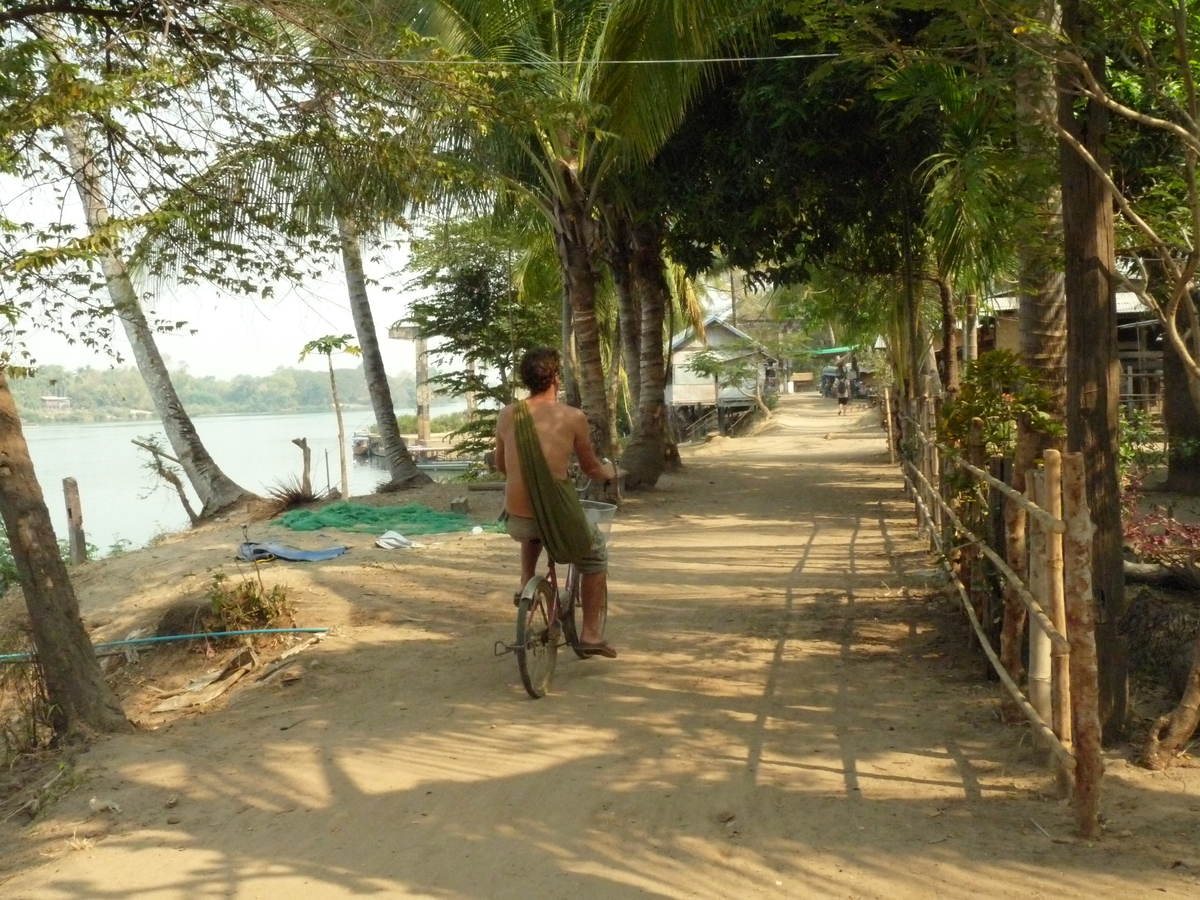
We toured the small island on push-bikes....


...and were pleasantly meandering by the water's edge one afternoon when an old Laos guy, caked in brown clay as he was making an outdoor oven, got my attention by throwing a lump of mushy clay at me. He missed thankfully, but beckoned me over and though he didn't speak 2 words of english, through some animated gesturing he proceeded to predict the course of our lives over the next few years... using our birthdates, gender and a strange 16-sided calender shape drawn in the dirt.


First he described the last few years and how they were for us (spot on), then moving onto predicting when we'll have a house, get married, have kids... I won't tell you exactly what he said but the dates struck close to home!